Cocoknits Emma (Frogged)

A white woman takes a selfie in a mirror while wearing a partially finished grey and cream v-neck sweater

Pattern/Technique: Cocoknits Emma Sweater, View A

Modifications: Started waist shaping at 2 inches below the underarm CO (at fullest part of but with bra on).

  • Waist shaping: Repeated waist decrease round every 4th round (3 times total) to obtain 124 stitches

  • Hip increases: Repeated hip increase 3 times (4 times total) every 4th round

Materials: Knit Picks Simply Wool in Winkle & Wanda. Held 2 strands of this worsted yarn together to achieve marling. Purchased 5 skeins of each color for the project.

US11 knitting needle

New skills: Cocoknits sweater method

Lessons: The Cocoknits top-down method for sweaters is great—in particular I like that I can try on the sweater as I'm working on it and make fit adjustments on the fly.

Knit a swatch and check gauge for all sweater projects!! One thing I didn't realize is that row gauge is really important due to the way that the yoke is constructed and mine was slightly off so the fit isn't perfect in that area, but because yarn is stretchy it's pretty forgiving. However, I did a ton of reading about how to adjust row gauge (tl;dr it might be useful to eventually learn Portuguese purling) and in the future I'll be a lot more careful about swatching/checking gauge.

Fit notes: Overall I quite like the silhouette of this sweater and the way it conforms to my body shape without being too boxy (especially since it uses a chunky weight yarn). However, I'm not into the super-low neckline, which is even more pronounced because the seams roll under and the bottom stitches stretch out. I make this again I'd make View B instead.

What I'd do differently: Ultimately I decided to frog this project because even though I like the fit, I don't see myself wearing this regularly due to the overly low neckline and color. I started this project prior to exploring and building awareness of the colors I want to wear, and the creamy marled tones of this sweater don't feel like they fit in my wardrobe, which tends toward higher contrast pieces.

I think my plan will be to use this yarn to make a throw / baby blanket (maybe this: https://www.purlsoho.com/create/2020/03/11/colorblock-jute-stitch-blanket/ as I have enough yardage for the crib size) and try knitting Emma View B using the chunky Knit Picks Heathered Grey yarn I'd previously used for the Purl Soho Big Brioche Turtleneck (also frogged midway). The gauge on both patterns matches, so it should be an easy swap.

Care: n/a
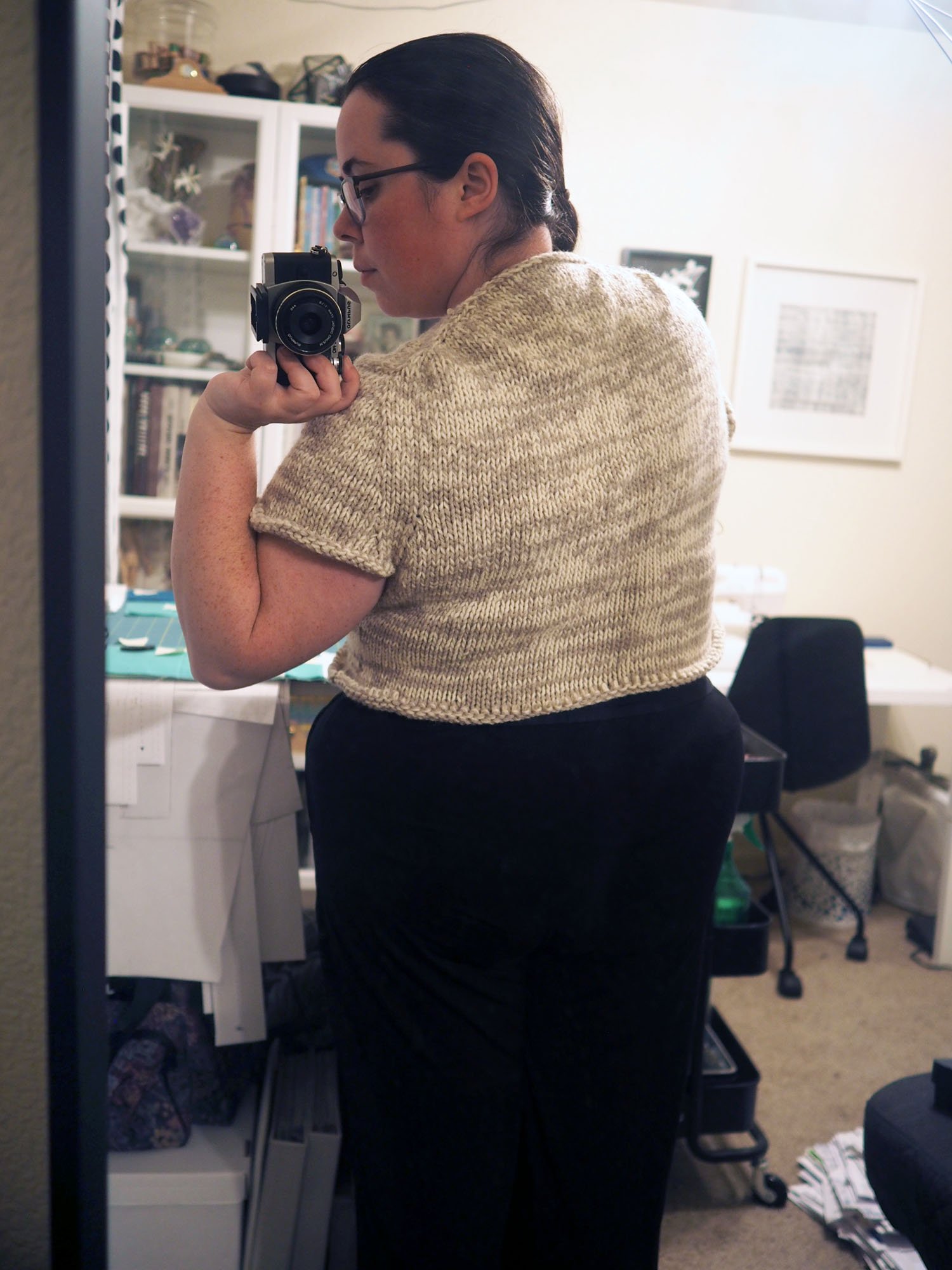
A white woman takes a selfie of her back in a mirror while wearing a partially finished grey and cream v-neck sweater
A white woman takes a selfie of her side in a mirror while wearing a partially finished grey and cream v-neck sweater

Hemp Basket

A handwoven basket made from linen and jute sits on a workbench.

Pattern/Technique: Basket weaving workshop by Flax & Twine via The Crafters Box

Modifications: none

Materials: 1 ball hemp twine, 1 ball woolen spun linen yarn (both provided in kit)

New skills: stitched basket construction

Lessons: How/where you stitch the basket influences the stability: I misheard the video and initially stitched to the left of each stitch (down through the front of the basket), which made an interesting coil pattern (and a really pretty feather pattern on the reverse) but as I increased the number of coils the outside started getting loose. I ripped everything back and used the actual technique in the video, which was to stitch to the right of each previous stitch (coming up from the back of the basket) which gave a more subtle feathering visual effect, and was more stable as the number of coils increased.

I noticed that the 18-20 coils were quite loose, so I went back and tightened the anchor stitches to snug up the coils. However, on row 21 you're supposed to tightly stitch all around the coil, and the width of the linen yarn actually snugged up the coils more and made the center of my basket slightly concave. In the future, I should not do any extra work to make the coils tighter before a densely stitched coil.

The linen yarn sheds and thins quite a bit, and if it looks like it's about to break it's totally fine to start with a new length.

When switching strands of linen yarn, weave in the old end in the next line of anchor stitches (and start the new strand in the same line) to keep the anchor stitches looking consistent.

When binding off the basket, you can do a set of 3-4 wraps with the linen yarn to secure the twine, then either weave in the end in the 3-4 wraps you just made, or a line of anchor stitches.

What I'd do differently: I think I may have held my yarn too slanted in the section where I started creating the basket shaping, and ended up with sides that were a little too curved, so I ended up binding off earlier than suggested. I'm really happy with how this first basket looks, but if I make a larger one in the future, I'd use a gentler slant in the shaping section so that I can get a large, shallow bowl.

Care: spot clean

A hand is holding a hand woven basket to show the back side of the piece.
A handwoven basket is tucked into a white geometric document holder. A small collection of pottery cups are sitting in the foreground.